


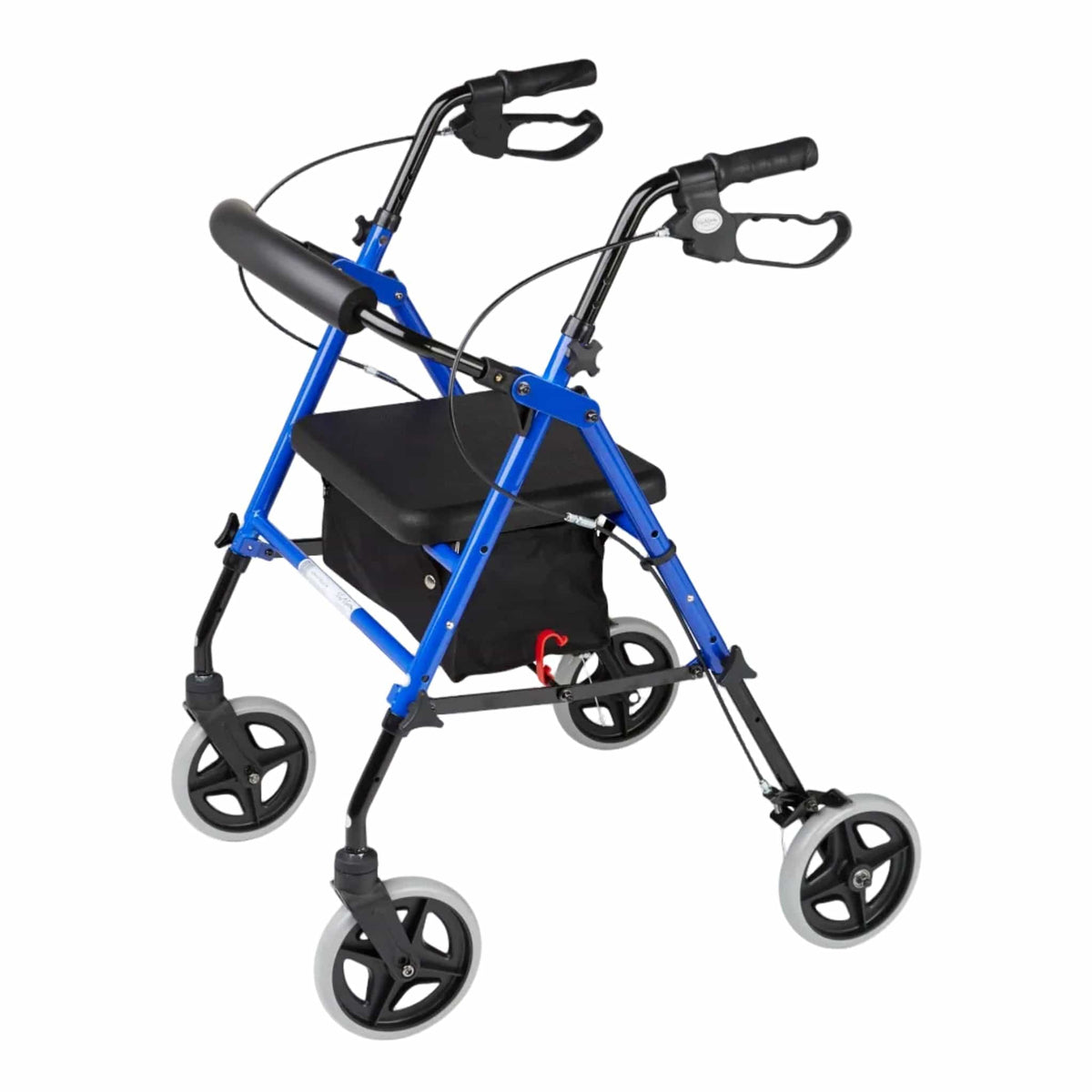
Rollators and folding walking frames can look similar in a photograph, but their wheels, brakes, seats and folding mechanisms can be very different. Compare the equipment's configuration and measurements before choosing a model.
This guide explains what to check and compares two examples from our range: the Max Mobility Alpha 427 Rollator and the Able Life Space Saver Walker. Browse rollators and walking frames to see the full selection.
What is a rollator?
A rollator is a wheeled walking aid. The Alpha 427 is a four-wheel example with hand-operated loop brakes, a seat and a storage bag. Other models differ in wheel size, seat design, handle adjustment and folding method.
Walking frame is a broader description. For example, the Able Life Space Saver Walker has two front wheels and rear ski glides. It does not have the same configuration as a four-wheel rollator. Check the exact model rather than relying on the words “walker” or “rollator” in a listing.
Start with the way the equipment will be used
Think about the routes it needs to fit through, where it will be stored and whether it needs to go in a car. Write down the narrowest doorway or passage, the available storage space and the dimensions of the car boot opening.
If you are unsure which type of walking support suits the person, a physiotherapist or occupational therapist can help assess that choice. A lighter frame or a higher price does not, by itself, make a product the right match.
Six specifications to compare
- Wheel and glide configuration. Look at how many wheels the model has, their size and whether it uses rear glides. Review the manufacturer's intended surfaces and use conditions.
- Brakes and controls. Check how the controls work and whether the person can operate them as intended. Do not assume two models have the same braking system.
- Handle adjustment. Confirm the minimum and maximum handle height. Adjustable handles still need to cover the required setting.
- Seat and backrest. If the model has a seat, compare its height, width and depth. A walking aid without a seat is a different choice. Follow the model's instructions for seated use.
- Overall and folded dimensions. Check the open footprint for doorways and the full folded size for transport. One quoted folded measurement does not describe every dimension.
- Equipment weight and user capacity. Product weight affects handling and loading. Maximum user weight is a separate limit. Storage bags and baskets can have their own load limits too.
Alpha 427: a four-wheel rollator with a seat
The Max Mobility Alpha 427 Rollator has 7-inch wheels, loop brakes and a seat. Its aluminium frame weighs 6.5kg and has a maximum user weight of 125kg.
The supplier lists handle adjustment from 750mm to 990mm and seat adjustment from 460mm to 590mm. Its overall width is 610mm and depth is 750mm. The listed folded width is 160mm; confirm the remaining folded dimensions if you need it to fit a particular space.
This gives you a starting point for comparing a seated rollator. Open the product page and brochure to check the full specification and current options.
Able Life Space Saver: a compact folding walker
The Able Life Space Saver Walker has 6-inch front wheels and rear ski glides. The listed equipment weight is 3.4kg, with a maximum user weight of 140kg.
The supplier quotes collapsed dimensions of 36 inches high by 5.25 inches wide by 8 inches deep, approximately 91.4cm by 13.3cm by 20.3cm. Measure the full space available for storage, including the opening it must pass through. Check the product instructions for the folding and adjustment steps.
Its wheel-and-glide layout is a different configuration from the Alpha 427. Use that distinction when discussing the appropriate walking aid with your treating professional.
How to compare other rollators in the range
Our rollator and walking frame collection includes Max Mobility Alpha models and Stander folding options. Avoid carrying specifications from one model across to another, even when the brand or product names are similar.
For example, check the exact version of a Stander Wonder product: the Walker Plus, Rollator Plus and Heavy-Duty Rollator are separate products. Read the model's own user limit, dimensions and included features.
Seats, storage and accessories
A seat on a rollator does not make it a transport wheelchair. Check the manufacturer's instructions for sitting and braking; do not use a walking aid to push a seated person unless its manufacturer explicitly permits that use.
Before adding a bag, basket, cup holder or replacement part, check compatibility with the exact model. Account for any storage already supplied with the walking aid and the separate accessory load limit. You can find components in Parts & Accessories, or ask us to confirm a match before ordering.
Your buying checklist
- Confirm the type of walking support and control system required.
- Compare handle range, overall width and any seat measurements.
- Check equipment weight, user limit and storage load limits separately.
- Measure the storage or vehicle space using all folded dimensions.
- Read the exact model's brochure and instructions.
Shop rollators and walking frames, or explore all Mobility Aids for the wider range. If a measurement or compatibility detail is missing, contact Sensory Assist before purchasing.
Model facts checked on 24 October 2026 using current listings and supplier specifications for the Alpha 427 and Space Saver Walker. Follow the instructions supplied with your equipment.